
In the late 19th century, a group of forward‑thinking printers in Cincinnati helped transform playing cards from a cottage craft into a modern industrial product.
Russell, Morgan & Co., founded by Anthony Octavius Russell, Robert James Morgan, John Franklin Robinson Jr., and James Monroe Armstrong, would go on to change how the world shuffles and deals.
The company’s story began in 1867 with the purchase of the Cincinnati Enquirer’s job printing rooms. What started as a regional printing operation steadily expanded, and by the early 1880s the firm had built a purpose‑designed playing card factory—one of the most advanced of its kind.
Russell was an early champion of entering the playing card business, seeing opportunity despite stiff competition from established eastern manufacturers. But while Russell set the vision, Victor Mauger played a critical role in execution, becoming the driving force behind the company’s dedicated playing card division and day‑to‑day production efforts.
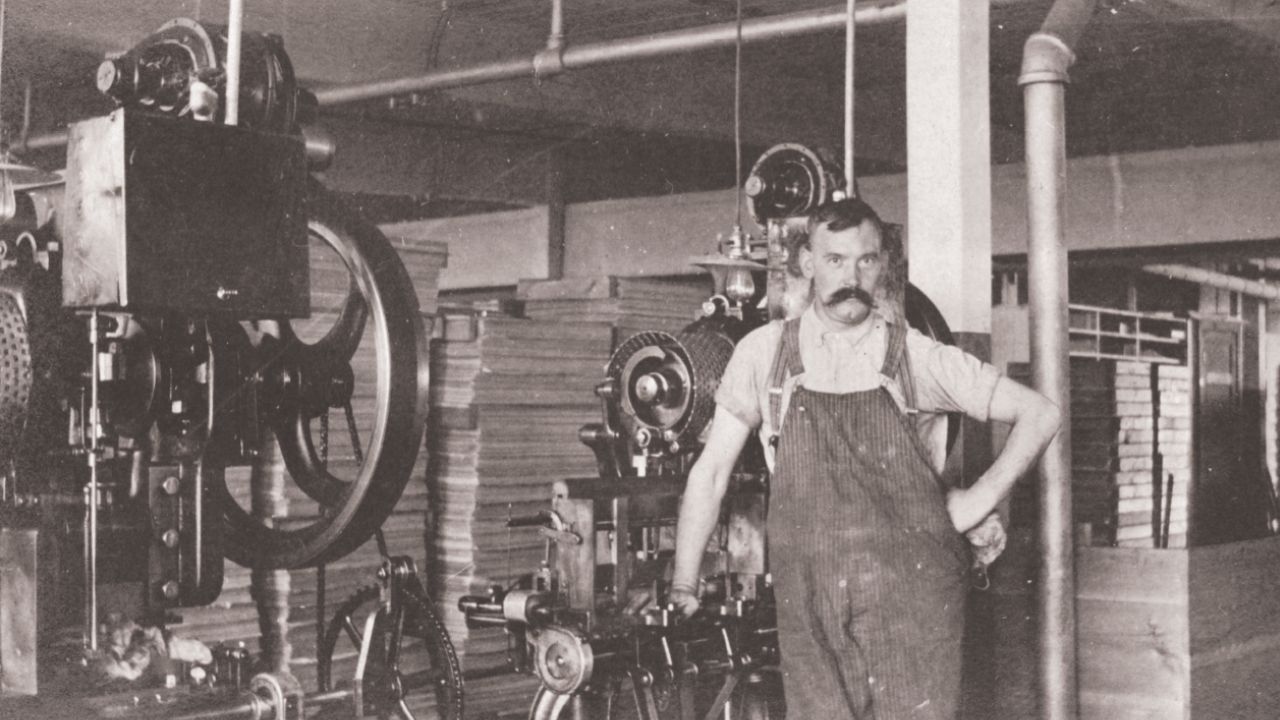
A major advantage for Russell, Morgan & Co. was its embrace of mechanization. The company adopted precision machinery that dramatically improved consistency and output. That progress accelerated with the use of Samuel J. Murray’s 1888 card‑punching invention, a patented machine that allowed for unprecedented accuracy. Though Murray invented and patented the technology, Russell, Morgan & Co. were the assignee, integrating it directly into large‑scale production.
By 1881, the company produced its first complete pack of playing cards. Just four years later, in 1885, Bicycle® Playing Cards were printed for the first time - beginning a legacy that would make Bicycle the most popular playing cards in the world. Production scaled rapidly, reaching as many as 30,000 decks per day within just a few years.
Robert J. Morgan oversaw much of that growth on the factory floor. When the first pack came off the line, he famously handed it to Russell and said, “That pack of cards cost thirty‑five thousand dollars!” A reminder of how much investment and belief went into building the business.
In 1894, continued expansion led to the formation of The United States Playing Card Company (USPCC). In the early 1900s, USPCC introduced another lasting innovation: Air Cushion® Finish, created by embossing paper with a specialized roller to improve handling and durability
Together, these people and innovations helped define what modern playing cards would become—setting standards that still shape decks around the world today.
